
Claude Opus: What Opus 5 and 5.5 Are, What They Cost, and When Each Came Out
Claude Opus is Anthropic's high-end model line; the newest, Opus 5.5, came out September 22, 2026, and starts on Claude's $20-a-month Pro plan.

On this page
- What is Claude Opus?
- Every Opus version and its release date
- How much does Claude Opus cost?
- Can you use Claude Opus for free?
- Opus 5.5 in Pat Simmons's builds
- Opus vs GPT-6, Gemini, GLM and Kimi
- Opus vs Sonnet, Fable and Claude Code
- Where to use Opus: the app, Claude Code, Copilot
- Questions people ask about Claude Opus
Claude Opus is Anthropic's line of high-end Claude models. It sits above Sonnet and Haiku and below Fable, which Anthropic recommends for its most demanding work. The newest version is Opus 5.5, released on September 22, 2026, and Opus 5 came out on July 24, 2026, at half the per-token price of Fable 5.
Opus isn't on Claude's Free plan. It starts on the $20-a-month Pro plan, and Anthropic's API charges $4 per million input tokens and $20 per million output tokens for Opus 5.5. In Pat Simmons's same-prompt builds against Fable 5.1 and GPT-6 Astra, Opus 5.5 won all three, and it cost the most at $106.93, against $90.99 for Fable 5.1 and $60.20 for Astra.
Last checked November 25, 2026: Opus prices on Anthropic's API pricing page and Claude's plans page, and the release date of every Opus version on Anthropic's own announcement for it.
What is Claude Opus?
Claude Opus is a line of AI models made by Anthropic, so the answer to "who makes Opus 5" is Anthropic. Opus belongs to Claude: it is one of the four model lines Anthropic sells today, alongside Haiku, Sonnet and Fable.
Anthropic's models overview gives each current model a one-line job. Opus 5.5 is "for long-running agentic coding and knowledge work," meaning jobs where the AI works through many steps on its own, such as building an app or working through a long report. Sonnet 5.5 is "the best combination of speed and intelligence," Haiku 5.5 is for fast, high-volume tasks, and Fable 5.2 is "for demanding reasoning and long-horizon agentic work."
The same page tells developers to start with Opus 5.5 for most workloads and to move up to Fable 5.2 when Opus 5.5 at a higher effort setting still falls short.
People also search for "Opus 5.0". Anthropic's own name for that model is Opus 5, with no ".0" on the end.
Every Opus version and its release date
Anthropic released six Opus versions between November 2025 and September 2026, and the newest is Opus 5.5, from September 22, 2026. Each date below links to Anthropic's own announcement for that version.
| Version | Released | API price per million tokens (input / output) | Pat Simmons's review |
|---|---|---|---|
| Opus 5.5 | September 22, 2026 (announcement linked above) | $4 / $20 | Embedded in the builds section below |
| Opus 5 | July 24, 2026 | $5 / $25 | His verdict at 27:10 |
| Opus 4.8 | May 28, 2026 | $5 / $25 | Its flight simulator at 11:15 |
| Opus 4.7 | April 16, 2026 | $5 / $25 | Its one-prompt flight simulator at 6:27 |
| Opus 4.6 | February 5, 2026 | $5 / $25 | Not reviewed |
| Opus 4.5 | November 24, 2025 | $5 / $25 | Not reviewed |
Prices are the list prices on Anthropic's API pricing page, checked November 25, 2026. That page still lists the older Opus 4 and Opus 4.1 at $15 per million input tokens and $75 per million output tokens, three times what Opus 4.5 through Opus 5 cost.
Anthropic's Opus 5 announcement says the model "comes close to the frontier intelligence of Claude Fable 5 at half the price," and per token it is half: $5 and $25 against $10 and $50 for Fable 5. In the Opus 5 vs Opus 4.8 vs Fable 5 builds, Opus 5 cost less than Fable 5 on all five, including $16.00 against $33.25 for a browser game, and the older Opus 4.8 cost less than Opus 5 on three of the five. Pat's verdict in his Opus 5 review was that it "was across the board better at 3D, creative web design, game development, motion graphics, and knowledge work."
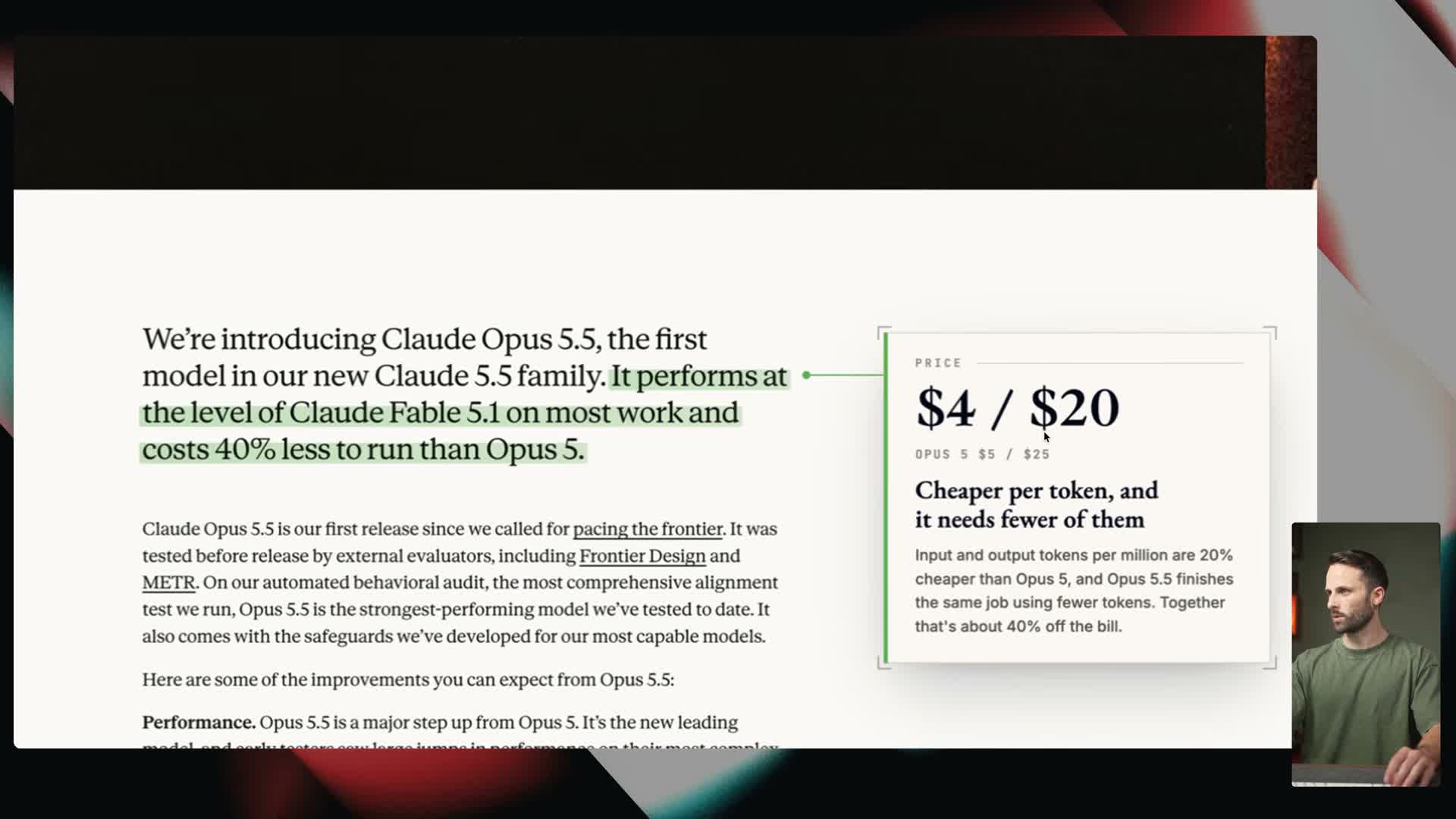
Opus 5.5 followed two months later. Anthropic says it "performs at the level of Claude Fable 5.1 on most work and costs 40% less to run than Opus 5," and its price per token is 20% lower, at $4 and $20.
How much does Claude Opus cost?
Claude Opus costs $20 a month on Claude's Pro plan, or $17 a month if you pay $200 for the year up front, and the Max ($100 a month) and Ultra ($200 a month) plans include it too. Developers who pay per use through Anthropic's API pay $4 per million input tokens and $20 per million output tokens for Opus 5.5. Tokens are the small chunks of text a model reads (input) and writes (output).
Claude's pricing page lists four individual plans, and Opus starts on the second one:
| Plan | Price | Opus | Claude Code | Usage |
|---|---|---|---|---|
| Free | $0 | No | No | Limited every 5 hours and every week |
| Pro | $20 a month, or $17 a month billed yearly | Yes | Yes | More usage than Free, every 5 hours and every week |
| Max | $100 a month | Yes | Yes | 5 times Pro |
| Ultra | $200 a month | Yes | Yes | 10 times Pro each week, no 5-hour limit for verified accounts |
On the API, Opus sits in the middle of Anthropic's price list:
| Model | Input, per million tokens | Output, per million tokens | Cache reads, per million tokens |
|---|---|---|---|
| Fable 5.2 | $8 | $40 | $0.20 |
| Opus 5.5 | $4 | $20 | $0.20 |
| Opus 5 | $5 | $25 | $0.50 |
| Sonnet 5.5 | $2 | $10 | $0.10 |
| Haiku 5.5 | From $0.10 | From $0.50 | From $0.01 |
Cache reads are the discounted rate for text the model has already read earlier in the same job, which adds up on long coding work where it re-reads the same files. Haiku 5.5's lower rates apply to prompts up to 100,000 tokens. Fast mode, which runs Opus 5.5 up to 2.5 times faster, costs twice the standard price.
Opus 5.5 costs twice as much per token as Sonnet 5.5 and half as much as Fable 5.2. Anthropic links the Opus price to what the model costs to run: its Opus 5.5 announcement says the model "requires less compute to serve than Opus 5, and its pricing reflects that," and that at default settings it will cost 40% less than Opus 5 on typical workloads.
What a job costs also depends on how many tokens it uses. Anthropic's pricing page notes that Claude 4.7 and later models use a newer tokenizer that "produces approximately 30% more tokens for the same text." In Pat's three-build test, Opus 5.5 had the lowest price per token of the three models and still finished as the most expensive, because it read 266.6 million input tokens against 62.9 million for Fable 5.1 and 39.5 million for GPT-6 Astra.
Can you use Claude Opus for free?
Claude Opus isn't free. The plan table on Claude's pricing page marks Opus as not included on Free and included on Pro, Max and Ultra, so the cheapest way to use it in the Claude apps is Pro at $20 a month. Free gives you Sonnet and Haiku with usage limits every five hours and every week, and what Claude's Free plan includes covers the rest of that plan.
GitHub Copilot's free plan doesn't let you pick Opus either. GitHub's supported-models page says Copilot Free and Copilot Student users "have access to models through auto model selection only."
Opus 5.5 in Pat Simmons's builds
Pat Simmons ranked Opus 5.5 first on all three builds when he gave it, Claude Fable 5.1 and GPT-6 Astra the same prompts, and Opus 5.5 was also the most expensive of the three to run. The three jobs were scenes from Moby-Dick drawn entirely in code in the style of a risograph print, a launch film with its own sound, and a 3D skateboarding game.
Each model got the prompt once and worked on its own until the build was finished: Opus 5.5 and Fable 5.1 in Claude Code and GPT-6 Astra in Codex, all at high effort. The costs are API-equivalent, meaning each run's real token counts priced at the model's list rates, though the builds ran on subscriptions.
| Build | Opus 5.5 | Fable 5.1 | GPT-6 Astra | Pat's pick |
|---|---|---|---|---|
| Moby-Dick scenes drawn in code | $37.22, 85 min | $42.18, 63 min | $8.16, 30 min | Opus 5.5 |
| Launch film | $11.66, 40 min | $16.55, 25 min | $7.96, 23 min | Opus 5.5 |
| 3D skateboarding game | $58.05, 142 min | $32.26, 56 min | $44.08, 49 min | Opus 5.5 |
| All three | $106.93, 266 min | $90.99, 143 min | $60.20, 102 min | Opus 5.5 on all three |
Opus 5.5 cost less than Fable 5.1 on the Moby-Dick scenes and the launch film, and far more on the skateboarding game, where it worked for 142 minutes.
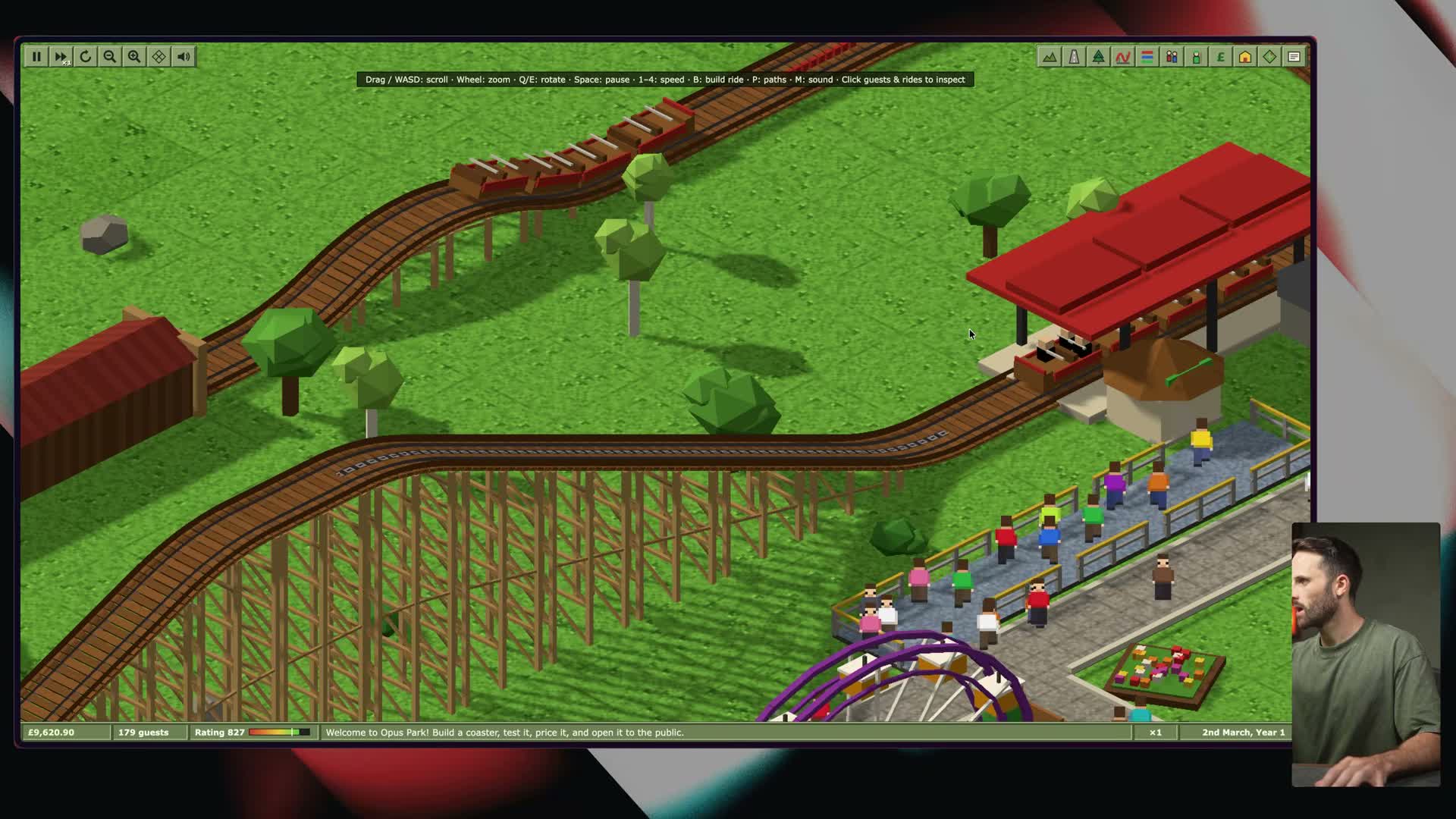
In his launch review of Opus 5.5, Pat gave the same three models four other one-prompt builds and ranked them blind. Opus 5.5 placed first on two, a rebuild of the Mana Yerba Mate website and a clone of the game RollerCoaster Tycoon 2, and second on the other two, a clone of an Awwwards-winning website and a 3D model of an Adidas running shoe. Those four builds cost $224.24 for Opus 5.5, $403.38 for Fable 5.1 and $196.87 for Astra, according to the full Opus 5.5 review with build costs.
Astra won the running shoe, which it modeled in Blender for $13.31, and that result led Pat to say "Astra still might be the king of 3D" (33:47 in the review). His summary at 33:53 was that "across those four tests, Opus came in first, twice, second, and second," and at 34:22 he said, "It's something you'll probably rely on over Fable 5.1."
His plan after the review was to keep testing Fable "when it comes to really heavy coding tasks, very long running tasks" (34:30) and to use Opus 5.5 for everything else. The full review is below: Anthropic's prices and benchmarks for Opus 5.5 in the first few minutes, then the four builds side by side with what each cost.
Opus vs GPT-6, Gemini, GLM and Kimi
In Pat's tests Opus 5.5 placed above GPT-6 Astra and Gemini 4 Argon on most builds while costing more to run, and cheaper models came close on everyday writing and office work: Gemini 4 Neon at about a seventh of Opus 5.5's cost, and GLM 5.2 against the older Opus 4.8 at four to five times cheaper.
GPT-6 Astra vs Opus 5.5
Opus 5.5 beat GPT-6 Astra on all three same-prompt builds in the table above and on three of the four builds in the launch review, and Astra was cheaper both times: $60.20 against $106.93 for the three builds, and $196.87 against $224.24 for the four. Astra's one win was the 3D running shoe.
Gemini vs Claude Opus
On four identical builds ranked blind, Opus 5.5 placed first every time and Gemini 4 Argon placed last, and Argon cost far less to run (Claude vs Gemini on the same builds).
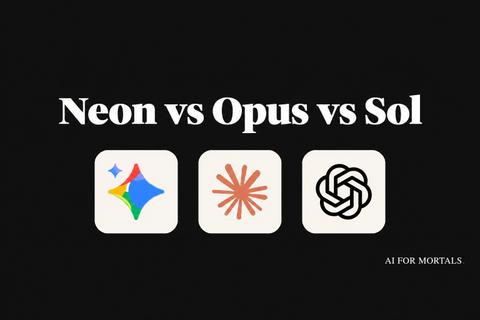
Gemini 4 Neon came closer. In Pat's video "I Made Gemini 4-Neon, Opus-5.5 & GPT-6.2 Sol Build the Same Apps (RAW RESULTS)", the three models made a Vox-style animated explainer, a full AI newsletter issue and a website for a running apparel brand. At 40:20 he said "Opus 5.5 still kind of edged it out on a few things, like the Vox Explainer", "but it really wasn't by a whole lot. And Neon, of course, did it for about a seventh of the cost." For 3D work, building an app from scratch and refactoring code, he said he would "still recommend Opus 5.5 or Fable 5.2" (40:41).
GLM 5.2 vs Opus 4.8
Pat's video "Is GLM 5.2 ACTUALLY Better Than Opus 4.8? (Full Breakdown)" ran the open-source model GLM 5.2 against Opus 4.8 on builds and office tasks, with the cost of each. On office work, he said at 36:31, "writing, organizing a pile of notes, building decks, pulling sense out of a spreadsheet, GLM 5.2 was right there with Opus 4.8. So, very similar quality for four to five times cheaper." He added that he'd "have a hard time telling anyone not to run GLM 5.2 as a daily driver."
Kimi K3 vs Opus 4.8
In "Kimi K3 Is Here! (Better Than Opus 4.8?)", Pat ranked Kimi K3 against Opus 4.8, GPT-5.6 Sol, GLM 5.2 and Kimi K2.7 on coding and office-work builds. His conclusion at 35:27 was that most people aren't doing hard coding tasks all day, and "for an open-source model that is much cheaper than any of the frontiers, Kimi K3 seems like a good selection."
Qwen vs Opus 5.5
In our own test of five office jobs, Qwen4-Max matched Opus 5.5 on every one at about a sixth of the cost.
Opus vs Sonnet, Fable and Claude Code
Sonnet is Anthropic's cheaper everyday model, Fable is its pricier top model, and Claude Code is an app that runs Anthropic's models, with Opus as one of the choices.
Sonnet 5.5 costs half as much per token as Opus 5.5. In Claude Sonnet vs Opus, ranked blind, Opus 5.5 placed above Sonnet 5.5 on two of the three blind rankings, a launch video and a website rebuild, and Sonnet 5.5 placed above it on a horror game. Sonnet used more tokens on most of the five builds, so the post's sum of all five runs came to $118.33 for Sonnet 5.5 against $107.67 for Opus 5.5. Pat recommends Sonnet 5.5 as an everyday default on medium effort and hands heavy 3D web work to Opus.
Fable 5.2 costs twice as much per token as Opus 5.5. In Fable 5.2 vs Opus 5.5 on five office jobs, three of the jobs were a tie, Fable won the other two on details, and it cost about twice as much to get there.
Claude Code is Anthropic's coding agent, and Claude's pricing page includes it on Pro, Max and Ultra. It runs more than one Claude model: Pat's three-build test above ran both Opus 5.5 and Fable 5.1 in it. Anthropic's models overview lists medium as Opus 5.5's default effort, the setting that controls how long the model reasons before it answers.
Where to use Opus: the app, Claude Code, Copilot
You can use Opus in the Claude apps on Pro or a higher plan, in Claude Code, through Anthropic's API and the big cloud platforms, and in GitHub Copilot.
Anthropic's announcement says Opus 5.5 is "available on all platforms, including Amazon Web Services, Google Cloud, and Microsoft Azure," and developers call it on Anthropic's API as claude-opus-5-5. For what changes in Claude itself from one release to the next, see Claude updates and new features.
In GitHub Copilot, GitHub's supported-models page lists Claude Opus 5.5 as generally available and included in Copilot Chat, Copilot CLI, the Copilot cloud agent and the GitHub Copilot app. GitHub's plans page lists Copilot Pro at $10 a month and Copilot Pro+ at $39 a month, and Pro+ is the plan whose card lists "access to premium models, including Opus."
Questions people ask about Claude Opus
Who makes Claude Opus 5?
Anthropic makes Opus 5 and every other Claude model. Opus 5 came out on July 24, 2026, and Opus 5.5 replaced it as the newest Opus on September 22, 2026.
When did Claude Opus 4.5 come out, and what does its API cost?
Anthropic announced Opus 4.5 on November 24, 2025. Its API pricing page lists it at $5 per million input tokens and $25 per million output tokens, the same as Opus 4.6, 4.7, 4.8 and 5.
Is Claude Opus 4.8 still available?
Anthropic's API pricing page still lists Opus 4.8 at $5 and $25 per million tokens, and fast mode for Opus 4.8 is deprecated. GitHub retired Opus 4.8 from Copilot on November 16, 2026, though individual Copilot subscribers on annual plans can still use it, per GitHub's supported-models page.
Is Opus 5.5 worth it over Opus 5?
Opus 5.5 costs less per token than Opus 5, $4 and $20 against $5 and $25, and its cache reads dropped from $0.50 to $0.20 per million tokens. After going through those prices at 2:01 in his review, Pat said "it makes absolutely no sense to use Opus 5 again."
How much text can Opus 5.5 handle at once?
Anthropic's models overview lists a context window of 1 million tokens for Opus 5.5, which is how much it can read in one conversation, and up to 128,000 tokens in a single reply.
Did Opus 5.5 change Claude's usage limits?
Anthropic said with the Opus 5.5 launch that it was increasing the five-hour usage limits on the Pro, Max, Team and seat-based Enterprise plans, and giving subscribers a rate-limit reset they can save and use whenever they choose.
Sources
- Anthropic: Claude Opus 5.5 announcement
- Anthropic: Claude Opus 5 announcement
- Anthropic: Claude Opus 4.8 announcement
- Anthropic: Claude Opus 4.7 announcement
- Anthropic: Claude Opus 4.6 announcement
- Anthropic: Claude Opus 4.5 announcement
- Anthropic: API pricing
- Anthropic: models overview
- Claude: plans and pricing
- GitHub Docs: supported AI models in Copilot
- GitHub: Copilot plans


Comments
Sign in to join the conversation.